

Yesterday was a busy re-introduction to all that’s happening in Brisbane.
First up, I attended a community meeting, “The Future of East Brisbane” in which Councillor Jonathan Sri addressed a group of local residents, outlining his vision for the area. The key issues raised for discussion were:
Disconnection - there is a perceived lack of a strong geographic community in the area. This was linked to housing stability (see below), but also to the deleterious effect of several major multi-lane roads cutting through the area, creating isolated pockets of suburbia with no associated public spaces / amenities accessible by foot.
Access / public transport - a map showing high-frequency transport (primarily bus) networks in the inner city made it clear that East Brisbane is something of a black hole as far as access goes. This means residents are entirely reliant on cars, despite living within 1km of the city centre.
Safety - both in terms of traffic and crime. High traffic volumes, both from local residents getting around the suburb and commuters coming through on one of the major arterial roads, make many local streets unsafe for kids to play or older folks to walk, meaning people tend to retreat from the street. The result is less passive surveillance and higher rates of petty crime, such as theft and vandalism.
Housing stability - 60% of East Brisbane (and the Gabba Ward as a whole) residents are renters, with an average tenure of 18months, so transience and precarious living situations are the norm. It was pointed out that this affects the entire community, as both settled and transient residents are unable to develop strong ties with their neighbours. Meanwhile, 1/8 houses in the area lies empty.
Sustainability and the localised effects of climate change - water restrictions (Queensland is often in drought), flooding (like other delta cities, Brisbane is braced for increasingly frequent and damaging floods due to rising seas), food security (over-reliance on trucked produce from dought-prone agricultural areas to the west), and increasing average summertime temperatures (Brisbane already regularly experiences regular 40 degree + days each year), were all raised as talking points.
Sri introduced some basic planning ideas aimed at “reimagining” the streets as pedestrian-friendly, localised and informal community spaces. These included narrowing streets to vehicles and introducing community planting / food growing initiatives in the (consequently wider) grass verges, reintroducing local businesses like corner shops by tinkering with commercial / residential zoning restrictions, and making existing public spaces such as parks more useable / less “anti-social” by introducing basic facilities such as barbecues, shade structures, and toilets.
Attendees at the meeting raised additional concerns around:
Loss of heritage buildings - particular more recent (1960s, 70s) buildings
Reinstating local business - how to encourage this?
Over-development - with reference to the proliferation of tower blocks currently under construction, and the associated increases in traffic volumes, etc.
Decision-making / input to the local neighbourhood plan.
Overall it was a very positive discussion, with lots of good ideas thrown around. It was interesting to note the extent to which the views and concerns of these mostly older, by standard measures “conservative”, residents actually align very closely with the proposals of a supposedly radical politician. In fact, in his calls to 'decentralise and localise’ both the economy and democracy, Sri is arguably calling for a return to a more traditional model of living - one that places decision-making in the hands of those whom it most directly affects.
ELEVATED pitch

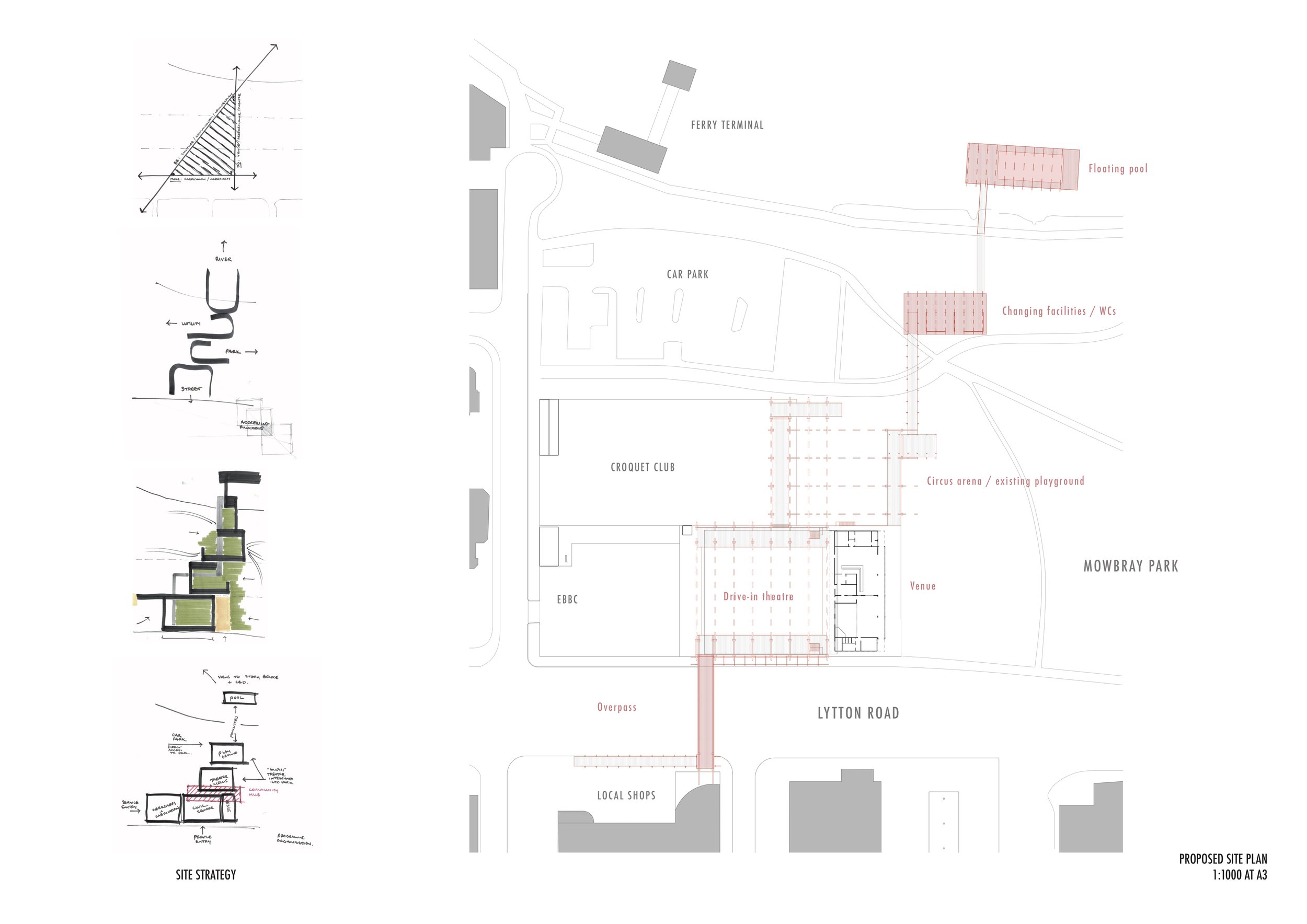
Concept proposal for East Brisbane Bowls Club from my Pilot Study
Next I headed over to East Brisbane Bowls Club (EBBC) - home of Backbone Inc, a youth arts organisation working with emerging theatre makers and musicians (and the site for my Pilot Project concept proposal). I met with Backbone CEO and Artistic Director Kath Quigley and her colleague Stephen Quinn, the venue manager, to catch up on the latest goings on around the venue and the local area.
We discussed some of the current issues facing Backbone & the venue itself. Funding is an ever-present challenge, though the organisation remains inspirationally active and engaged with its target communities. However, the widening of Lytton Road continues to make much of this activity invisible to the local neighbourhood, particularly as much of it occurs in the evening - the venue simply looks like it is part of a construction site, completely cut off from both the street and Mowbray Park behind.
EBBC is not the only space suffering the consequences of the road widening though - the anchor café tenancy directly across the road has been vacant for 9 months, and local grocers, post office, and other small businesses (including an award-winning fish and chip shop!) facing the road have closed.
Using some of the sketches and images from my Pilot Project, I briefly introduced some of my thinking around how these issues might be highlighted through some kind of temporary intervention - perhaps a theatre set stretching between the river and the road (see above). We also discussed how such a project might fit in with their programme for the coming months. Two events in particular stood out as possible collaborations / case studies / design tests - Open Homes (Oct) and Backbone Festival (Nov).
~
Open Homes is a theatre project specifically prompted by the compulsory purchase and demolition of several nearby homes due to the road widening. It aims to open up local residents’ homes as a stage from which they can tell their own stories of place to a public audience. Each event is to be produced as a collaboration between Backbone theatre-makers and the residents themselves. Interesting opportunities for an intersecting documentation of both local lore and architecture.
Backbone Festival is the company’s big annual event, taking place over three weekends in November. It is a platform for young and emerging artists in Brisbane to develop new work. This might be a good opportunity to put some of the ideas of the Pilot Project into practice with Unqualified Design Studio, alumni of Backbone’s Open Source + Go programme.
RADICAL READING

BFU “term card” for 2019. Artwork by Mama See.
Finally, I rounded the evening off with some chewy discussion over a cup of tea and homemade cookies. The topic was police surveillance - something I haven’t considered much, but one which definitely presents some very interesting angles on the rhetoric of a New World City. Questions arose about the slavery / prison complex and its relationship to the settler-colonial nation-state: Is prison labour simply the 21st equivalent of slavery? Is this indentured labour more or less essential to the machinations of capitalism? What does it mean to “reform” an institution like the police? How can we ask these questions in the context of a society built on convict labour..?